





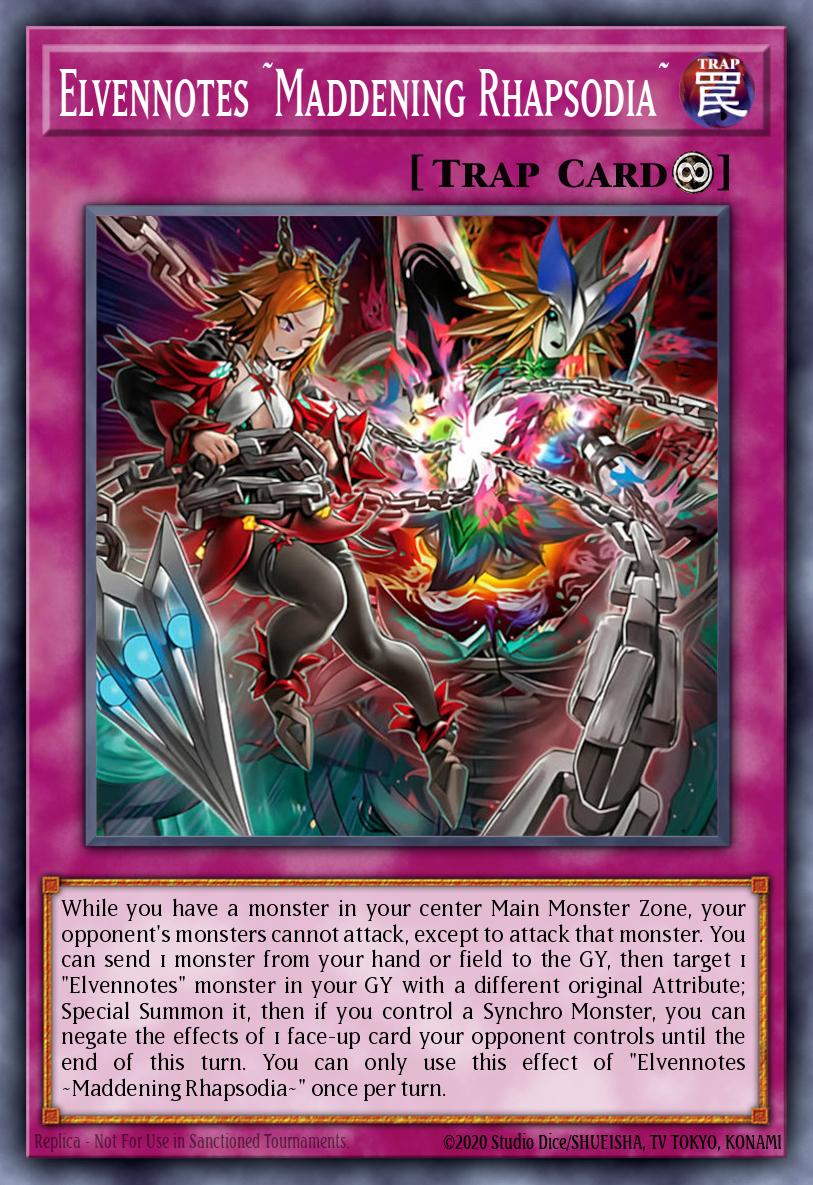

 Trap
 Continuous
Elfnotes: Rhapsodia of Madness
Archetype:
Elfnote
View:
2643
While you control a monster in your center Main Monster Zone, your opponent's monsters cannot attack, except to attack that monster. You can send 1 monster from your hand or field to the GY, then target 1 "Elfnote" monster in your GY with a different original Attribute; Special Summon it, then if you control a Synchro Monster, you can negate the effects of 1 face-up card your opponent controls until the end of this turn. You can only use this effect of "Elfnotes: Rhapsodia of Madness" once per turn.
Elfnotes: Rhapsodia of Madness — Power Evaluation
Final Score: 60 ± 6 · Confidence: Medium
- Intrinsic: 56.4 · Deck: 62.9 · Meta: provisional
- Primary role: Recovery / Recursion · Secondary: Floodgate/Control, Negation/Interaction
Why it scores here
The card is a continuous trap whose value is a conditional attack lock while a monster sits in the center Main Monster Zone, plus a once-per-turn recursion that trades a hand or field card for a Special Summon of a GY Elfnote with a different original Attribute. It is in 400 of 400 sampled decks at one copy and appears in all 21 recorded combos, so it is clearly a live, practical piece of the Elfnote shell. The evidence does not show it as a starter, searcher, or material in any recorded board (all role counts are zero), so the score does not rest on high combo power, which comes from the boards overall, and the ATK-free, rarity-free, and popularity signals (view count, Top-Card rank 44) earned no points. The Synchro-conditional negate and the empty role data keep the confidence at Medium.
Axis scores
| Axis | Score | Evidence |
|---|---|---|
| Accessibility | 60 | Played in all 400 sampled decks at one copy, but no searcher or starter route is recorded and the draw odds of one copy are modest (inferred from deck data; observed in decks, inferred in route). |
| Combo & Conversion | 65 | Present in 21 of 21 recorded combos with average power index 64.7, though its own role in those boards is empty, so credit is shared with the boards it sits in (observed). |
| Resource Economy | 50 | Recursion costs one card from hand or field to revive one GY monster, which is roughly card-neutral and yields a body, with no draw or repeated advantage (verified from text, inferred for net value). |
| Effect & Interaction | 60 | The attack lock is strong while a center-zone monster stands and the negate is real but needs a Synchro monster on your side, so it is conditional (verified from text, inferred for strength). |
| Material Utility | 10 | A Trap card with no material or level body, so it cannot contribute as material even when the effects are not used (verified from text). |
| Resilience & Flexibility | 55 | A face-up continuous trap is exposed to destruction and removal, and the once-per-turn limit caps repeat use, partly offset by its appearance in 97.8% of decks with Ash Blossom & Joyous Spring (verified from text, observed for co-occurrence). |
| Deck-Building Efficiency | 80 | One copy in nearly every Elfnote list with no garnet or brick restriction, so it is close to a free roll inside its archetype (observed from deck data). |
Calculation
Weight profile: 0.7 Recovery/Recursion + 0.3 Floodgate/Control. Intrinsic ≈ 56.4, Deck ≈ 62.9, Meta = provisional. Modifiers: none. Final formula: 0.40*Intrinsic + 0.60*Deck
Strengths
- Conditional attack lock that protects the center-zone Elfnote engine
- Recursion that converts a hand or field card into a GY-revived body with no net card loss
- Near-free slot cost, one copy in virtually every sampled Elfnote list
- Co-appears with the core Elfnote partners in nearly all sampled decks
Weaknesses
- Lock and negate both depend on a center-zone monster or a Synchro monster being present
- Once-per-turn limit on the recursion effect
- No recorded starter, searcher, or material role, so its practical route to live use is unproven in the data
- Continuous trap that can be removed or destroyed by opponent effects
Counters / choke points
- Destruction or removal of the face-up continuous trap by opponent card effects
- Clearing or dismantling the center-zone monster that switches on the attack lock
Best use
Recursion engine with a conditional attack lock for Elfnote boards. Decks: Elfnote (archetype 2370, gameplay 7), Elfnote (archetype 2366, gameplay 6), Power Patron (archetype 2266, gameplay 7). Suggested copies: 1.
Evidence & gaps
- Verified: Card text: continuous attack lock while a monster is in the center Main Monster Zone, with the exception for attacks on that monster; Card text: once-per-turn cost of one hand or field card to GY, then Special Summon of a GY Elfnote with a different original Attribute; Card text: Synchro-conditional negate of one face-up opponent card until end of turn; Decks: 400 of 400 sampled decks run it in the main deck, average 1 copy; Combos: present in 21 of 21 recorded combos
- Observed: Average structural power index of boards containing it is 64.7; Average starter count when present is 0.95; Appears across 41 distinct archetypes in the sample; Top-Card rank 44 in TCG and 92 in OCG
- Inferred: Primary role is recursion with a secondary floodgate function, based on text; Negate is practically reachable only in boards with a Synchro monster; Net card value of the recursion is roughly neutral
- Data gaps: No banlist token; assumed 3 copies (unlimited) All combo role counts (starter, searched, material, payoff, end-board, end-hand) are zero despite 21 appearances, and example combo role arrays are empty No official rulings supplied for the continuous lock and recursion timing interaction No dated metagame sample, so meta power is null